
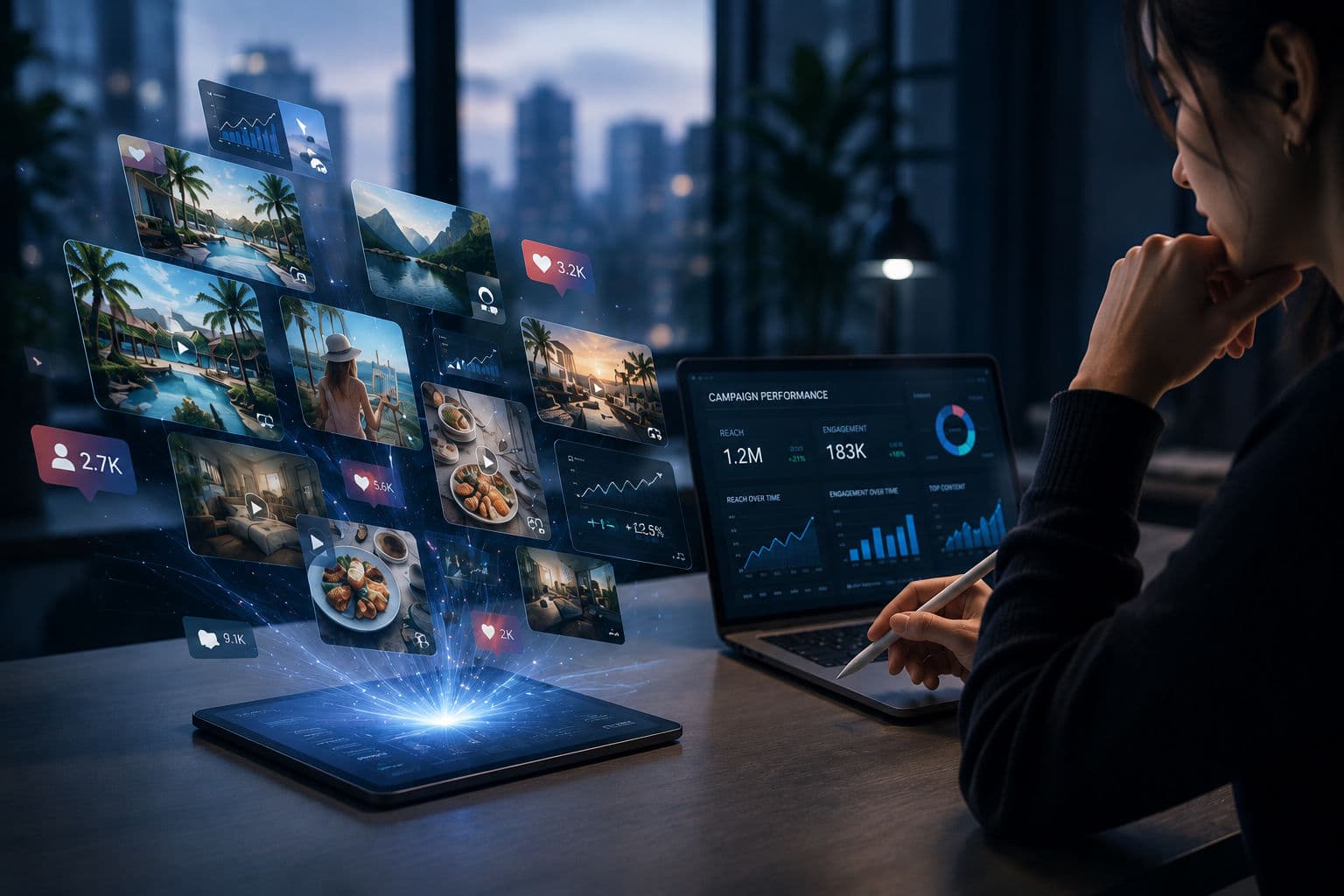
Artificial intelligence has changed marketing faster than most people expected. Today, brands can use AI to research audiences, analyse data, generate content, personalise communication and automate parts of their marketing in minutes. What once took a team hours can sometimes be done in seconds.
But there is a catch. When everyone has access to the same AI tools, producing more content is no longer a competitive advantage. The real advantage is knowing what is worth creating in the first place.
AI Can Make Marketing Faster. It Can't Make It Meaningful.
The internet already gave brands an abundance of content. AI has taken that abundance to another level. There are more posts, more reels, more advertisements, and more perfectly polished visuals competing for the same few seconds of attention. The problem was never a lack of content. It was a lack of ideas worth remembering.
AI can generate a caption about a hotel, a campaign for a consumer brand or ten variations of an advertisement. But it doesn't automatically know what will make someone stop scrolling, trust a brand or choose it over a competitor. That still comes down to strategy, context and creativity.
The Future of Marketing Is Human Creativity + AI
This is where the conversation around AI in marketing needs to change. The question shouldn't be whether AI will replace creative teams. It should be how creative teams can use AI to become better.
AI can take care of a lot of the work that slows marketing teams down. It can analyse thousands of customer reviews, identify patterns in campaign data, research audiences, generate multiple creative directions and help repurpose content across platforms.
That gives marketers something extremely valuable: time.
But what we do with that time matters more than how much time we save. Instead of spending hours producing variations, teams can spend more time understanding the customer. Instead of manually analysing data, they can focus on what the data actually means. Instead of producing more content, they can work on better ideas.
AI in Marketing Needs Human Strategy
This distinction becomes especially important when working with established brands. A brand isn't simply a logo, a product or a collection of social media posts. It has a history, a personality, an audience and a reputation to protect.
A luxury hotel cannot suddenly sound like a start-up because AI generated a “trendy” caption. A legacy consumer brand cannot abandon its identity every time a new social media trend appears. A wellness brand cannot sacrifice credibility simply because a particular format is generating views.
AI can provide options. Human judgement decides which options make sense.
That judgement is becoming one of the most important parts of modern marketing.
When Data Meets Creativity
AI also changes the way marketers can use data.
Customer reviews, social conversations, campaign performance and audience behaviour contain enormous amounts of information. Traditionally, analysing all of it could take significant time. AI can help identify patterns much faster.
But data doesn't automatically become insight.
Knowing that a particular post received more shares is useful. Understanding why people shared it is more valuable. Knowing that a campaign performed well is useful. Understanding what made the audience care is what helps you build the next one.
The best AI marketing strategies will therefore combine data with human interpretation. AI can surface the pattern. People still need to understand the story behind it.
Creativity Becomes More Valuable When Production Becomes Easier
When everyone can generate an image, the idea behind the image matters more.
When everyone can write a caption, the point of view behind the caption matters more.
When everyone can produce a video, knowing what deserves to become a video matters more.
This is why we believe AI will not make creativity less important. It will make good creativity easier to recognise.
Our work with Dr. Mickey Mehta followed a similar principle. The challenge wasn't to create a completely new personality for an established wellness expert. It was to translate existing credibility into content that could connect with a digital audience.
The “Fittest at 55” campaign generated more than 4 million impressions because it found an interesting story within something that was already true. The campaign didn't need technology to invent a new truth. It needed creativity to present an existing truth in a way people wanted to engage with.
The Best Marketing Teams Will Use AI Differently
The future won't belong to brands that use the most AI. It will belong to brands that understand where AI creates leverage.
Use AI to research faster.
Use it to analyse faster
Use it to automate repetitive work.
Use it to test more ideas.
Use it to personalise communication.
But don't outsource the decisions that define your brand.
Don't outsource your point of view.
Don't outsource your understanding of your customer.
And don't confuse efficiency with effectiveness.
Marketing is not successful because a team produced 100 pieces of content instead of 20. It is successful when the right piece of content reaches the right person and gives them a reason to care.
AI Is a Marketing Tool. Creativity Is the Competitive Advantage.
The next phase of digital marketing will not be a battle between humans and machines. It will be a combination of both.
AI brings speed, scale, data and efficiency. Human creativity brings context, emotion, instinct, cultural understanding and judgement.
Neither is enough on its own.
Together, they can fundamentally change how brands approach marketing.
For businesses competing for attention in increasingly crowded markets, that distinction matters. Your competitors have access to the same AI tools. Your customers are seeing the same AI-generated formats. The opportunity is to use that technology differently — to give your people more time to think, create and make better decisions.
Because consumers aren't looking for AI.
They are looking for something that catches their attention, earns their trust and gives them a reason to choose you. And that still starts with a human idea.
The future of marketing isn't AI. It's AI + human creativity.